
What Did the Caller Actually Search For?

What did a reader ask me yesterday?
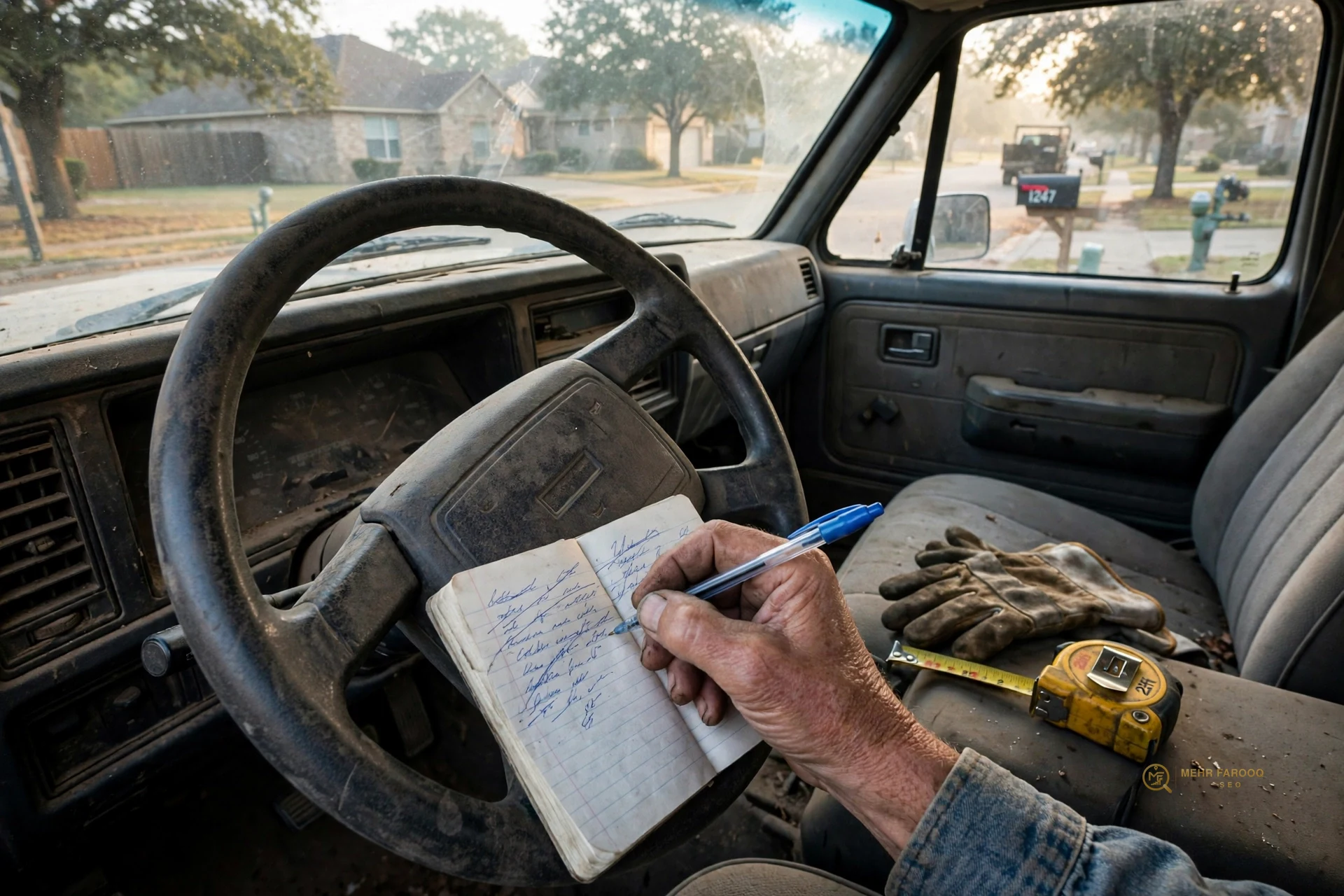
Yesterday’s post ended with a question, and a reader on Threads answered it with a better one. I had written honestly that no, I do not know what the caller typed into Google before my Houston roofing site’s phone rang — the call tracker records the call, not the words. His reply was not a tool or a plugin. It was a notebook. Ask the caller, on the call, “what did you search for?” — jot it down, every time, and a month of that tells you more than any tracker.
He is right, and his fix is better than most of the software sold for this problem. A month of real answers, in the customers’ own words, beats a dashboard’s best guess about intent. There is only one difficulty, and it is the subject of this post: I cannot use it. Not because it is low-tech. Because on my sites, I am never the person who answers the phone.
Why can’t I just ask the caller?
The calls to my roofing site do not come to me. They route straight to a local contractor in Houston — the business that can actually climb the ladder — while I sit in Karachi, Pakistan, looking at a log. The homeowner with the leaking roof has never heard my voice, and I have never heard hers. There is no moment in that chain where I can lean in and ask what she searched for.
That distance is not a flaw I am confessing; it is the shape of the work. I build and rank the page, the network routes the call, the contractor does the roofing. But it means the most honest measurement advice I have been given all year — ask, and write it down — has to survive a translation before I can use it. What is the notebook, for someone who never takes the call?
So what is my notebook?
The call recording. Every call to that number is logged and recorded, and what the record holds is the need in the customer’s own words — the problem as they described it, in their situation, with their urgency — rather than a keyword report’s guess at it. My one converted call from 3 November sits in that log at a little over nine minutes, marked converted, $98 recorded against it. Yesterday’s post took that call apart as proof about AI. Today I am interested in it as paper: it is the page of a notebook I did not have to hold a pen to write.
Notice what this notebook can never contain. It cannot tell me the exact words typed into the search box. Those are gone the moment the phone is picked up, and no recording recovers them. What it holds instead is the thing the typed words were only ever pointing at: a real problem, in a real house, that needed a person. A search query is a shadow of a need. The recording is the need, casting it.

What can a recording tell you that a dashboard can’t?
Dashboards measure the beginning of the chain: impressions, clicks, which queries a site is found for, in aggregate. That is genuinely useful — it is how I know what my pages are being summarised for. But it is all beginnings. The recording measures the end of the chain, the only end a business can deposit: what the customer actually wanted, how they described it, whether it matched what the page promised. When those two ends disagree, the dashboard will never tell you. The notebook will.
This is also where the AI fear takes its proper size. An answer box can absorb the beginning of the chain — the informational click — and I have published my own fading pages as evidence that it does. It cannot absorb the end. Nobody has ever had a roof repaired by a summary. So the part of the record that survives this era intact is exactly the part the notebook holds, and the part the trackers were never built to see.
Does that make the trackers useless?
No — it makes them specialists, and the mistake is asking one tool another tool’s question. Search Console tells me what my sites are found for overall; it was never going to tie one phone call to one typed query, and I said so yesterday rather than pretend otherwise. My own portfolio site’s numbers keep me humble in the other direction: 4 clicks and 76 impressions in its entire recorded history. I publish that next to the $98 because small numbers, reported both ways, are the whole method of this blog.
Each instrument answers one question well. The console: are you being found, and for what? The tracker: did the phone ring, and for how long? The recording: what did the caller actually need? A business that reads all three knows its market. A business that reads only the first is steering by the weather at the start of the road, in a year when the weather is exactly what is changing.
What should you write in your notebook this month?
If you answer your own phone, steal the reader’s fix exactly as given — it costs a pen. Ask “what did you search for?”, or “how did you find us?”, write the answer down before the van door closes, and read the month back in one sitting. You will learn which of your pages and profiles earn their keep in the only currency that pays rent, and you will hear your customers’ own words for their problems — which is the raw material of every good page this blog has ever recommended writing.
If, like me, the calls never reach you, then make the recording your notebook and actually read it: one sitting a month, log open, listening for the need in the customer’s words and checking it against what your pages promise. Either way, the habit is the same and it is older than the internet: the business that writes down what its customers say knows something no competitor’s dashboard subscription can buy.
So what did your last caller actually need?
The short version: I still cannot tell you what my caller typed, and I will not dress a guess up as data. What I can tell you is what she needed, because that part was recorded — and in the AI-answer era, the need is the part of the chain that was never in danger. Trackers watch the road. The notebook records the arrival.
So here is today’s question, and it is my reader’s fix turned back on every business owner reading: when your phone last rang, do you know what that caller actually needed — in their words, not your dashboard’s — and where is it written down?
Want SEO built on proof, not promises?
I build and rank websites for home service businesses — and I test everything on my own sites first.