
Do Reviews Matter More When AI Writes the Answers?

What changed when the answers started writing themselves?
Choosing a local business used to mean reading two things: what the business said about itself, and what strangers said about it. Now an AI answer speaks first. It can summarise the service, quote a rough price, state the opening hours — fluently, instantly, and without ever having stood in the shop. For information, that is enough, and the last three posts on this blog are about the pages that lost their clicks to exactly that fluency.
But notice what the summary cannot do. It cannot stand behind any of it. The moment money is about to move — a repair booked, a deposit paid, a stranger let into the house — the searcher goes looking for the one thing no answer can generate: evidence that real people used this business, recently, and were glad they did. That evidence has a name. It is the review section, and this post argues it is worth more in the AI era, not less.
What can an AI answer not do for a customer?
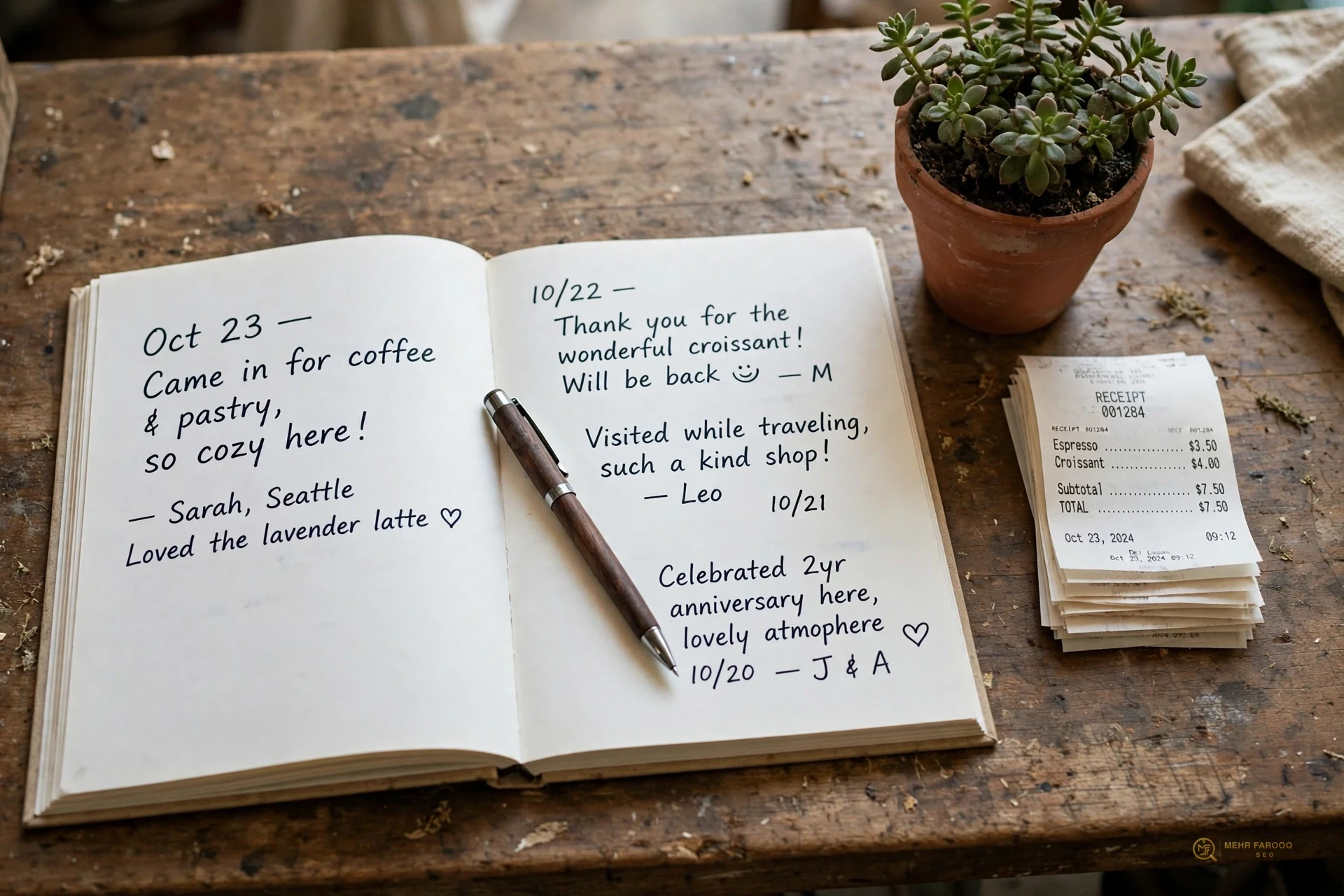
It cannot be a witness. An AI answer can quote witnesses — review text is among the material answers are assembled from — but a summary carries no risk and no history. A review carries both: a name, a date, a specific job, sometimes a photo of the finished work. When a customer reads “they came the same evening and fixed it properly,” they are not reading information. They are reading testimony, and testimony is what decisions are actually made of.
It also cannot warn the way a pattern of reviews warns. Three detailed complaints about the same thing, spread over a year, tell a story no summary preserves. And the reverse is just as true: a mixed record, answered honestly by the owner, reads as truthful in a way a polished paragraph never does. Summaries flatten texture. Reviews are texture.
What do I see on my own profile?
My real numbers, as always on this blog. My Google Business Profile has been viewed around 20,800 times. Sit with what a profile view is: not a casual reader, but a person mid-decision, checking exactly the trust signals this post is about — the rating, the recent reviews, the photos, whether the business bothers to reply. On the content side, one of my sites, a UAE salary guide, took 1,652 impressions in the last 28 days, and the pages earning them were the ones answering one exact question for one exact place.
Those two numbers teach the same lesson from opposite ends. Pages and answers get you found; proof gets you chosen. The AI pressure everyone is worried about lands almost entirely on the “found” half. The “chosen” half still runs on what customers said, in public, with their names attached. A business can lose the first half to a summary and still win the second — but only if the proof exists.
Why does one honest review outweigh a page of self-description?
Because the incentives point in opposite directions. Everything a business writes about itself is advertising, and every reader knows it. A review is the one text on the page the business did not write and cannot edit. Its specifics are what make it believable: the job named, the day named, the small imperfection admitted. That kind of detail is hard to fake convincingly and easy to recognise when it is real.
There is a second, newer reason. The AI answers themselves lean on review text when they describe a business. A real review earned today feeds two readers at once: the human deciding tonight, and the machine summary that will describe the business tomorrow. Self-description mostly feeds the business’s own hopes. Reviews feed the record.
Where do reviews stop helping?
Honesty again, because this blog keeps it. Reviews stop helping when there are three of them and the newest is two years old — that reads as a business that stopped, whatever the rating says. They stop helping when fifty five-star reviews say nothing specific at all; readers have learned what bought praise looks like, and platforms have too. And they stop helping when the bad ones sit unanswered, because the reply — or its absence — is part of the record strangers read.
They can also turn dangerous when a business tries to game them. Bought reviews, reviews traded for discounts, profiles padded by friends: this is the one shortcut that can burn the whole asset, up to losing the profile itself. A rating is repaired the slow way or not at all — by a system that asks properly and replies properly, over time. There is no honest shortcut, and I do not sell one.
How do I ask for reviews without asking wrong?
Ask at the moment the customer is happiest — the job finished, the problem gone — in person or with one short message, and make it effortless: a direct link, nothing to search for, nothing to install. Ask everyone, not only the ones who seemed delighted; asking only happy customers is a filter, and filters on reviews are against the rules as well as against the point. Never offer anything in exchange. A review that was paid for, in money or in kindness owed, is not evidence — it is advertising wearing evidence’s clothes.
Then reply to every review, the grateful and the furious alike, briefly and like a person. And keep everything around the reviews in order — photos, hours, services — because nobody reads a rating in a vacuum; they read it on a profile, and a neglected profile makes good reviews look like an accident. Ask, make it easy, reply, repeat. A system, not an event.

What should you check on your own profile this week?
Open your profile the way a stranger would, and count what customers have said about you in the last ninety days — not ever, recently. Read your three newest reviews and your replies to them. Then ask whether the profile around them looks like a business that is still there. If a stranger had only that one screen to decide with, would they call you, or the competitor whose proof is fresher?
And here is the question this post owes you, the one I am asking across my own work: if the AI answer about your business were written tomorrow, out of the reviews your customers can see today — would it say what you would want it to say?
Want SEO built on proof, not promises?
I build and rank websites for home service businesses — and I test everything on my own sites first.